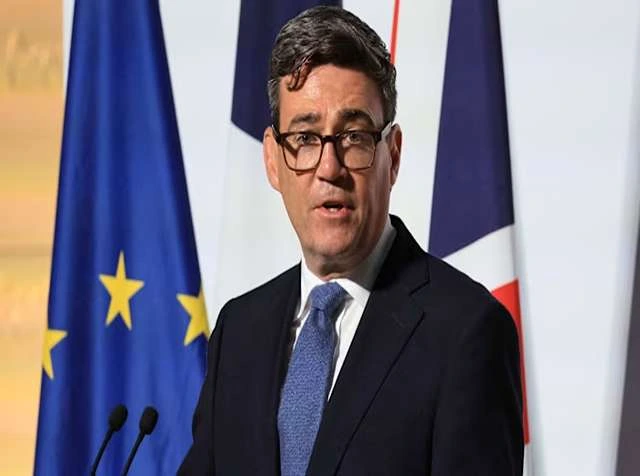


Prime Minister Andy Burnham and the European Union's top leaders sealed a package of post-Brexit "reset" deals at a summit in Brussels on Friday, covering food trade, carbon markets and a youth experience scheme. Within an hour of Burnham arriving at the venue, a Downing Street statement declared that "the deal is done – negotiations have concluded", according to the Guardian.
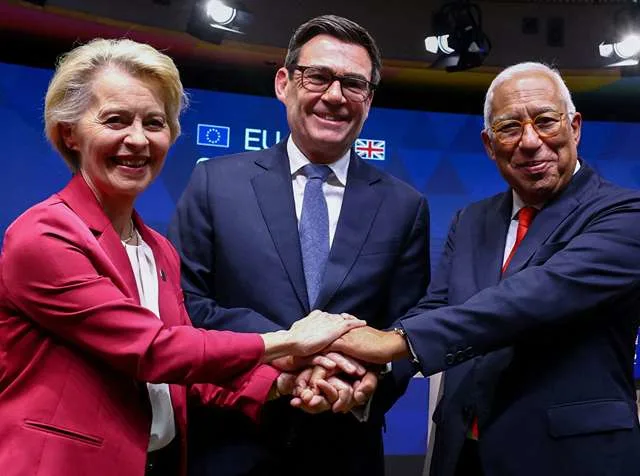
European Commission President Ursula von der Leyen called the day a "turning point" in relations, and Burnham told the gathering it was a good day for Britain and a good day for Europe, AFP reports. A string quintet played the UK and EU anthems as he shook hands with von der Leyen and European Council President António Costa.
The celebration came with a catch. EU member states have made clear that they will not sign off the three agreements until a separate deal on tuition fees for EU students at UK universities is reached, while Downing Street insists the deals stand on their own. Both sides have set a six-month deadline to settle the fee question.
At home, Burnham faces a sharp political backlash. Reform UK leader Nigel Farage has accused him of betraying Brexit voters, the Conservatives say farmers will be forced to follow rules they have no say over, and Labour is divided on how far the prime minister should go.
Burnham, who took office in July, says the agreements will cut costs, ease pressure on food prices and restore opportunities that Brexit took away from young people. He has also said he wants a wider conversation about Britain's long-term relationship with the EU.
What Was Agreed in Brussels
Three main agreements were concluded at the summit. The first is a food and agriculture deal designed to end most post-Brexit export checks. Under it, Britain would align with EU rules on food and plant health from March 2028, removing the need for many certificates and border checks on goods crossing the Channel, Brit Brief reports. Burnham said the deal gives a real prospect of lower weekly shopping bills.
The second links the UK and EU emissions trading schemes, which would shield British exporters from a carbon tax when they supply customers in the EU. Government officials claim the food deal could add up to £5.1bn a year to the economy and the carbon link £3.8bn a year, according to Brit Brief.
The third is a youth experience scheme with 100,000 places a year on each side, allowing young people aged 18 to 31 to live, work and study in each other's territories for up to three years, ITV News reports. Government documents say the first participants are expected to travel no later than January 2030. The scheme builds on Britain's agreed return to the Erasmus+ exchange programme in 2027, The PIE News notes.
Burnham also said Britain would take part in the EU's action plan on small boat crossings in the Channel, calling it a significant step on public concerns about illegal immigration. UK officials said they had also won agreement in principle to Britain's possible inclusion in the EU's "Made in Europe" industrial policy, which is still being finalised, the Guardian reports.
The government claims the package will lift economic output by 0.5%, or about £17bn, by 2040, according to ITV News. Burnham was joined in Brussels by Chancellor John Healey, Foreign Secretary Ed Miliband, First Secretary of State Louise Haigh and other senior ministers, which the Guardian described as a sign of how seriously London took the summit.
The Tuition Fees Row
The sticking point is what EU students should pay at UK universities. The EU wants them charged the same as British students, whose fees are capped at £9,790 this academic year, rather than international rates that can be four or five times higher, the Guardian reports. ITV News puts the highest international fees at up to £38,000 a year.
Talks ran late into Thursday night. According to the Guardian, the EU agreed to defer the fee decision by six months but will keep pressing for home rates, and the UK suggested in the final round that it could go as low as £12,000 for EU students, according to two EU sources. The joint summit statement commits both sides to conclude a fees agreement within six months, which Wonkhe calculates as around 20 May 2027.
The two sides then described the outcome differently. A statement from the EU institutions, seen by the Guardian, says the three agreements and a fees agreement providing equal treatment for students form a single package, and AFP reports that EU countries said they would hold off ratification until a fee agreement is reached. The UK points to the joint statement, which does not make the deals conditional on fees, and officials say the food arrangements will come into force in March 2028 regardless.
Von der Leyen described the fee work as a separate sheet of paper and said she was confident of a solution, Wonkhe reports. Miliband said it was "absolutely clear" the agreements would apply whatever happens on fees, ITV News reports.
Universities are watching closely. University of Manchester vice-chancellor Professor Duncan Ivison estimates that home fees for EU students would take about £500m a year out of the sector if no compensation were provided, and he said it is not clear universities could expand places for EU students anyway, according to ITV News. Universities UK chief executive Vivienne Stern welcomed the youth scheme as "pragmatic" but stressed that any fee changes must reflect universities' financial realities, The PIE News reports. Environment Secretary Angela Eagle said the Treasury and the Department for Education would work with universities during the negotiations.
Brexit Backlash at Home
Farage, who held his own press conference in Brussels, said Burnham was rejoining a chunk of the EU single market and turning Britain into a rule-taker. "The great Brexit debate has just started again," he said, Brit Brief reports. On X, he called the prime minister naive and said flexibility from Brussels was a fantasy, according to AFP.
The Conservatives accused the government of being ready to sell out British farmers by becoming a rule taker. Shadow environment secretary Victoria Atkins said farmers would have to follow rules over which Britain has no say, no vote and no veto, Brit Brief reports.
Reaction elsewhere was more measured. SDLP politician Matthew O'Toole called the agreement a sensible step towards undoing some of Brexit's damage but described it as "damage limitation, not a solution to every problem Brexit created". Irish Taoiseach Micheál Martin welcomed the deal as an important step forward, saying it will make it easier for Irish farmers and food producers to export to the UK, AFP reports.
Burnham has said he is sticking to the red lines in Labour's 2024 manifesto, which ruled out joining the single market or customs union or returning to freedom of movement, ITV News reports. Speaking on the BBC, Miliband said that applies to this parliament, but that "all the options will be on the table" in the longer term, including rejoining the EU.
What Happens Next
Miliband said legislation to implement the agreements will be introduced in Parliament, with the new arrangements due to start from 2028. Burnham said at the Brussels press conference that a bill would enter Parliament the following week, Wonkhe reports.
Burnham also plans informal "brainstorming" talks with the EU over the next 12 months on options for the long-term relationship before the next election, and will use the unveiling of his 10-year plan next month to set out ways Britain could move closer to the EU beyond this parliament, ITV News reports. Those options, AFP reports, could range from leaving things as they are to joining the customs union or becoming a member again.
The political calculation is clear. Polls regularly indicate that most Britons regret Brexit, and AFP reports that Burnham hopes friendlier EU relations will help build a broad centre-left coalition for the next general election, which is not expected until 2029. But the strategy carries real risks, not least because Labour itself is divided on how to proceed.
For now, the test is whether the six-month fee negotiation can be settled without unravelling agreements that Burnham has declared done, and whether voters see lower food prices and new opportunities for young people before the arguments over sovereignty take hold.