


London Underground drivers belonging to the RMT union walk out at midday on Thursday in the first of eight 24-hour strikes planned between now and late February, after last-ditch talks at the conciliation service Acas failed to settle a dispute over Transport for London’s plans for a voluntary four-day working week. The union confirmed on Tuesday that the action would go ahead, and the Evening Standard and Time Out report that disruption is expected on every line of the network, running into Black Friday, one of the busiest shopping days of the year.
The walkout is the latest round in a dispute that has already led to strikes earlier this year. TfL says its proposals would give drivers a real choice over their working pattern, and the rival drivers’ union Aslef has accepted them. The RMT argues that the package is voluntary in name only and could be used to cut jobs and weaken existing terms and conditions.
What Londoners Can Expect
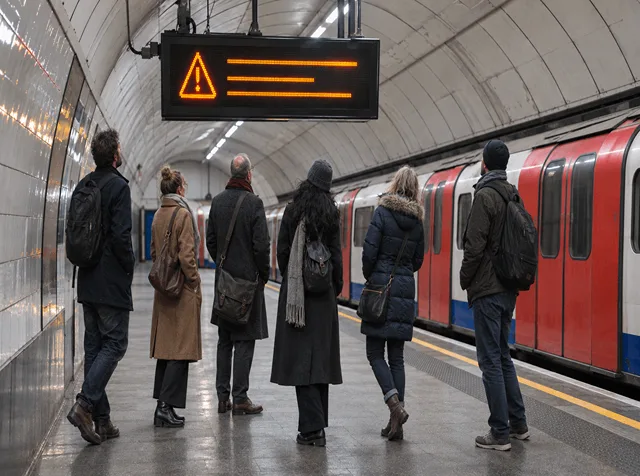
The strike runs from 12pm on Thursday 26 November until 11.59am on Friday 27 November, but its effects will be felt well beyond those hours. Time Out reports that disruption is likely from about 10am on Thursday until at least 6pm on Friday, because services wind down before the walkout and take time to recover afterwards. TfL expects a normal service until around 10am on Thursday, after which trains will start to be reduced. From midday most Tube services are expected to run, but with disruption on all lines, the Evening Standard reported.
The Circle and Piccadilly lines are not expected to run at all on Thursday, and the Waterloo & City line will have no service after midday. Time Out, citing TfL’s guidance, adds that no trains are expected anywhere on the network after 9pm. On Friday, services are due to start late, from about 7am, with disruption on all lines until around midday and no trains on the Circle, Piccadilly or Waterloo & City lines until the strike ends. Disruption is then expected to continue through the afternoon and evening, with a normal service returning by around 6pm.
The Elizabeth line, the Docklands Light Railway, London Overground, buses and trams are expected to keep running, though they are likely to be much busier than usual. Passengers are being urged to check the TfL Go app or the TfL website before travelling and to allow extra time for their journeys.
Why the RMT Is Striking
RMT general secretary Eddie Dempsey said the union is not opposed to a genuine four-day working week that benefits its members, but will not accept it being used as a vehicle for job cuts, more intensive working and the erosion of terms and conditions. He said London Underground must withdraw its proposals and engage seriously with the union to reach a negotiated settlement, according to the Evening Standard.
Speaking earlier this month, Dempsey told LBC there was nothing voluntary about a scheme that, in the union’s view, forces drivers to give up existing protections whether they work four days or five, and threatens those who refuse with displacement from their depots. He said members were being asked to spend more time driving trains, accept longer and more unpredictable shifts and surrender agreements that had been negotiated over many years. Railway Supply reported that Dempsey said the union had consistently sought a guarantee that no driver would be worse off, which management had not given, and that the RMT had already suspended strike action three times to allow talks to take place.
TfL and Aslef Push Back
Nick Dent, London Underground’s director of customer operations, called the strike disappointing. He said TfL had been in discussion with both unions for several months and had put forward a new, workable option to address some of their concerns. Under it, drivers who choose a four-day week, and those who stay on a five-day pattern with the same terms and conditions, would spend less time at work each year while delivering a more efficient and reliable service, and nobody would have to change depot. TfL has urged the RMT to put the new offer to its members, and CLH News reported that Dent had asked the union to postpone the action while further discussions continued.
Aslef, which has accepted the proposals and is not striking, has praised them as offering drivers the best working conditions on the rail network. LBC reports that around half of unionised Tube drivers belong to the RMT and the other half to Aslef, whose spokesman called a strike aimed at stopping people having the choice of a shorter working week a strange decision. Conservative shadow London minister Gareth Bacon dismissed the action as pointless when the dates were announced, the Evening Standard reported, while City AM noted that Dempsey has called on Sadiq Khan, the Mayor of London and chair of TfL, to withdraw the plans.
Black Friday and Christmas Trade Under Threat
The timing has drawn criticism from business leaders. Paul Swaddle, the Conservative leader of Westminster City Council, said Black Friday should be one of the busiest days of the year for the West End and accused the RMT of choosing it to bring the Tube to a crawl, according to the Evening Standard. Ros Morgan, chief executive of the Heart of London Business Alliance, which represents more than 500 businesses, also raised concerns about the impact on trade, IBTimes reported.
Hospitality groups are worried about December in particular. CLH News, the trade title for pubs, bars and hotels, noted that the strikes on 17 and 19 December fall in the middle of the Christmas party season and could lead to cancellations, reduced bookings and difficulties getting staff home after late shifts.
The Eight Strike Dates
All eight strikes are 24 hours long and begin at midday: Thursday 26 November, Thursday 17 December, Saturday 19 December, Monday 4 January, Wednesday 6 January, Wednesday 17 February, Tuesday 23 February and Thursday 25 February, according to the Evening Standard and LBC. TfL directs passengers to tfl.gov.uk/strikes for the latest information on each date.
What Happens Next
Both sides say they remain open to talks, but their positions have not moved. TfL wants the RMT to put its latest offer to members, while the union says the proposals must be withdrawn before it will settle. Unless there is a breakthrough, Londoners face repeated disruption through Christmas, the New Year and into the late winter. The central questions are whether the RMT will put the revised offer to its members, whether TfL is prepared to give the guarantees the union is seeking, and how much damage the walkouts do to the capital’s shops, pubs and restaurants in their busiest weeks of the year.