


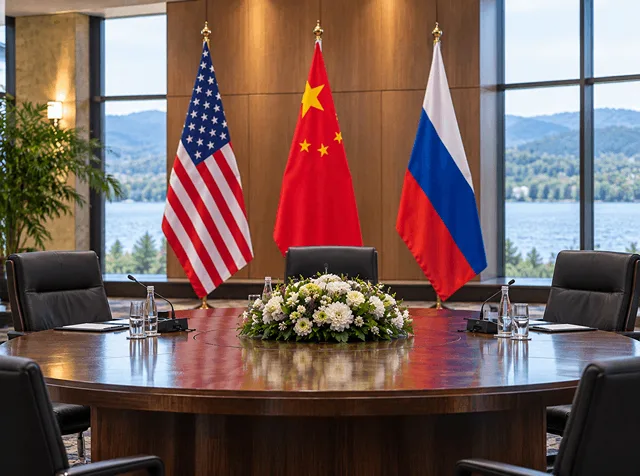
Donald Trump, Xi Jinping and Vladimir Putin held the first-ever three-way summit of their countries’ leaders in Shenzhen, China, on Thursday, and left with a short joint declaration on nuclear risks, United Nations reform and energy supply but no breakthrough on the wars in Ukraine or Iran. The meeting lasted roughly 70 minutes behind closed doors at the Kylin Villa, on the sidelines of the Asia-Pacific Economic Cooperation (APEC) summit.
The leaders billed the talks as historic, and in one sense they were: it was the first time the presidents of the United States, China and Russia had sat down together. But the outcome was far narrower than the rhetoric that came before it. Trump called the meeting “highly consequential” on social media as he flew home, then defended the trip at a White House press conference on Friday, where he offered few concrete results.
The summit came after a bruising few weeks for Trump at home, with his Republican Party losing heavily in the midterm elections, widespread tech outages unsettling Americans and Iran stepping up attacks on US allies.
What the Three Leaders Agreed in Shenzhen
After the meeting, the three governments released a brief “Declaration toward Peace” that set out four broad areas of agreement. According to Axios and the Associated Press, the leaders endorsed reform of the United Nations, higher refined petroleum production and oil supplies, immunity for state officials from foreign prosecution, and the principle that a nuclear war cannot be won and must never be fought.
The statement did not say what kind of UN reform the leaders had in mind, and it set out no cuts to nuclear arsenals and no timetable for negotiations. It also made no mention of Russia’s war in Ukraine or the US-led war in Iran, and it did not address Taiwan, which China treats as a domestic matter.
The clause on immunity was widely read as a rebuke of the International Criminal Court. Putin is wanted by the court under a 2023 arrest warrant over alleged war crimes in Ukraine, and the Trump administration has imposed sanctions on the court and its officials over its investigations into the United States and its allies, including Israel. In his opening remarks, Trump said he would propose ways to protect national sovereignty from what he called rogue globalist organizations.
Afterwards, Xi called the talks positive, constructive and fruitful, while Putin described them as open and candid and said the three-way format was useful and substantive.
Nuclear Arms, Iran and Ukraine Remain Unresolved
Trump said at the start of the talks that the three countries were uniquely placed to reduce the number of nuclear weapons and lessen the risk of their use. His stated goal for the meeting was denuclearization, but the last arms control treaty between Washington and Moscow, New START, expired in February, and Trump says he wants an improved and modernized replacement that also includes China.
China has little incentive to accept limits, the Associated Press noted, because its arsenal of more than 600 warheads is far smaller than the more than 5,000 each believed to be held by the United States and Russia. Daryl Kimball, executive director of the Arms Control Association, said the meeting could at best start a process leading to sustained talks, and that photo opportunities were no substitute for real negotiations.
On Iran, Trump said he and Xi agree that Tehran must fully reopen the Strait of Hormuz and cannot obtain a nuclear weapon. China and Russia both maintain ties with Tehran and have been accused by Washington of supporting it, but the Associated Press reported no sign that Trump secured a commitment from either leader to help end the conflict.
Ukraine featured mainly in the bilateral meetings. Putin’s spokesman Dmitry Peskov said it was not the main subject of the three-way talks. Trump held a separate sit-down with Putin, their first meeting since the Alaska summit last year, and called him a friend. He then dialled into a meeting in Berlin, where US envoys Steve Witkoff and Jared Kushner were talking to Ukrainian President Volodymyr Zelenskyy and more than 40 European leaders. Witkoff said Trump told them he had discussed a peaceful end to the war with Xi and Putin.
Xi Hosts, Putin Gains Standing, Trump Seeks a Reset
For Xi, simply hosting the event added to China’s growing diplomatic stature. Ruby Osman, a senior policy adviser at the Tony Blair Institute for Global Change, told the Associated Press that Beijing’s priority was to steer the meeting away from specifics and be seen as the responsible adult at the table.
For Putin, the talks were a chance to show that Russia sits alongside the United States and China as a superpower. He last attended an APEC summit in 2017. Xi greeted him on Wednesday as an old friend and Putin replied by calling Xi a dear friend, a warmth the Associated Press contrasted with Trump’s position: for all his praise of both men, he did not appear to share the deep common interests that bind Xi and Putin.
Trump framed the meeting as a beginning rather than an end point, telling Putin that good things could come out of it, or at least start there. Suzanne Maloney of the Brookings Institution told NPR that the trip let Trump bask in great-power amity after a bruising election result at home, and that Xi and Putin were already thinking about who may come after him.
Friction Behind the Friendly Optics
Signs of tension surfaced despite the warm tone. Chinese officials blocked a Bloomberg reporter from the trilateral meeting after she asked a question during the earlier session between Trump and Xi. Chinese television showed a video of Trump appearing drowsy, while the White House responded by posting a clip of Trump helping Xi up an escalator.
In their one-on-one meeting, the third substantial one between them this year, Trump said he and Xi shared an interest in keeping oil flowing through the Strait of Hormuz and suggested he would press Beijing to buy more American farm products. Xi described US-China relations under Trump as generally stable and improved and, according to Xinhua, raised Taiwan and said the two countries needed to improve communication on economic and trade issues.
Trump Defends the Trip at the White House
Speaking in the White House briefing room on Friday, with Vice President JD Vance and Secretary of State Marco Rubio standing behind him, Trump said the United States had gone into the trip from a position of unmatched economic and diplomatic strength. NPR reported that the trip produced mostly agreements to keep talking rather than concrete changes, with the meeting with Xi and Putin yielding only a pledge to keep discussing ways to reduce nuclear risks.
The one new announcement was that Trump and Xi have agreed to set up joint guardrails on artificial intelligence, a notable shift for a president who has argued that regulation would hold back American innovation. No details were given on what the guardrails would cover or when they would be agreed. Trump also said he wants only older chips sold to China and would be comfortable with none being sold, while noting that China makes its own chips.
Earlier in the trip, in Manila, Trump signed a trade agreement with Thailand that marks a substantial conclusion to negotiations, with details still to be finalised.
What Comes Next
Trump and Xi are due to meet again at the G20 summit in Florida in December, while the war in Ukraine and the conflict around the Strait of Hormuz remain unresolved. Allies that were not at the table, including Ukraine, Germany, France, the UK, Japan and South Korea, will be watching to see whether the Shenzhen declaration leads to any concrete negotiation or turns out to have been mostly a photo opportunity.