



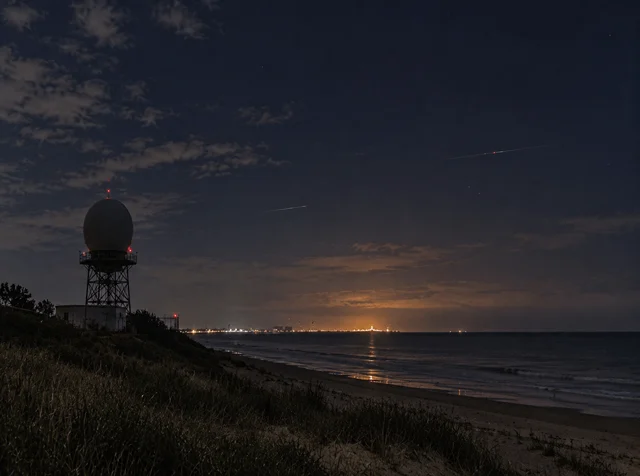
US fighter jets struck an Iranian missile launch site on Qeshm Island, near the Strait of Hormuz, on Tuesday evening, hours after Iran’s Revolutionary Guards said their drones had targeted a US-operated radar at Bahrain’s Sheikh Isa Air Base. A US military official told AFP that the aircraft used precision munitions and that the strike was carried out in self-defense.
The exchange adds to rising tensions in the Gulf at a time when efforts to end the war that began with US and Israeli strikes on Iran in late February appear stuck. Bahrain, which hosts the US Navy’s Fifth Fleet, said its air defenses intercepted the Iranian attack, and the US military said no American equipment was damaged and no personnel were hurt.
The Guards’ drone claim was the third of its kind against Bahrain in five days, following a weeks-long lull in Iranian attacks on Gulf states. A US military official described the Qeshm strike as a response to Iranian aggression aimed at US personnel and assets, while an Iranian provincial official said the attack on the island did not hit civilian areas.
The strikes landed as the US moved a third aircraft carrier, the USS Theodore Roosevelt, into the Middle East, and as President Donald Trump prepared for a three-way summit in China with Xi Jinping and Vladimir Putin at which the Iran war is on the agenda.
Iran Says Drones Targeted a US Radar at Sheikh Isa Air Base
The Revolutionary Guards said combat drones carried out a precision operation before dawn on Tuesday against a radar system operated by US forces at the Sheikh Isa Air Base in Bahrain. The Guards presented the attack as a response to what they called continued violations of Iranian airspace by American military drones.
They said the operation formed part of wider air-defense and electronic warfare efforts to track, destroy and capture US drones of the MQ and MQM-170 series, and warned that continued use of regional bases and military facilities for actions against Iran would not go unanswered.
Bahrain’s armed forces said they intercepted the Iranian aerial attacks before they could reach their targets. Blasts were heard over the capital, Manama, and the Interior Ministry urged residents to stay calm, move to the nearest safe place and follow only official sources, before an all-clear was given shortly afterward.
US Central Command said the Iranian drones aimed at the radar were intercepted without any damage to US equipment or injury to US personnel. The Guards’ statement itself did not offer evidence that the radar had been damaged.
Tuesday’s claim followed two earlier incidents. On Friday, the Guards said they had destroyed a US early-warning radar in Bahrain, a claim the US military rejected, saying it shot down two Iranian drones and recorded no damage. On Sunday, the Guards said six drones targeted an air-defense radar at Bahrain’s Riffa base, and Bahrain’s army said it intercepted that attack.
Friday’s strike was the first Iranian attack on a Gulf country since early September. Bahrain was heavily targeted earlier in the war, but the kingdom had been largely quiet for weeks before the latest run of drone attacks.
US Jets Hit an IRGC Missile Site on Qeshm Island
Later on Tuesday, a US military official said American fighter aircraft used precision munitions to strike an Islamic Revolutionary Guard Corps missile launch site on Qeshm Island. The official described the action as self-defense in response to Iranian aggression targeting US personnel and assets.
Iranian authorities confirmed that US forces had hit several locations on the island. Ahmad Nafisi, deputy governor of Iran’s southern Hormozgan province, told the state news agency IRNA that the attack caused no damage to residential, commercial or infrastructure areas, that the situation was under control and that relief agencies were on full alert. IRNA reported five to six explosions on the island on Tuesday evening.
Iranian media reported that an air-defense missile launcher in the island’s Nariman area was among the targets, and the Guards-affiliated Tasnim agency said several projectiles struck the island. The extent of any damage to military facilities was not clear.
The day before, Iranian forces claimed to have captured a US military drone south of Qeshm Island using electronic warfare systems.
Qeshm lies in the Strait of Hormuz, the narrow channel that normally carries about a fifth of the world’s oil. Since the war began on February 28, Iran has tried to restrict traffic through the strait and has insisted that ships use only routes it has authorized, while the US has responded with a naval blockade of Iranian ports and has escorted tankers.
Kuwait Reports Drone Attacks as Hormuz Shipping Comes Under Pressure
Late on Tuesday, Kuwait’s army said the country was under attack by drones and that any explosions heard were air-defense systems intercepting hostile targets. It did not say where the drones came from or whether there were casualties or damage.
Shipping in and around the strait also saw fresh incidents. Iran’s armed forces said three oil tankers struck naval mines while trying to cross the strait on Tuesday, although the US military says it has cleared the main routes of mines.
On Monday, the Panamanian-flagged tanker Tara Gas was struck about seven nautical miles north of Khasab in Oman, causing a fire in its engine room. The UK Maritime Trade Operations agency said the vessel was hit a second time, and India’s ports minister later said the crew had abandoned the ship and that one Indian sailor was missing. A second Panamanian-flagged tanker, the On Phoenix, was hit by an unidentified projectile off Oman’s coast the same day.
Diplomacy Stalls as a Three-Way Summit Approaches
Talks aimed at ending the war appear to be deadlocked. Iran’s foreign minister, Abbas Araghchi, met his Omani counterpart, Badr Albusaidi, in Muscat to discuss safeguarding shipping and diplomatic options, according to Omani news agencies.
The White House says Trump will hold an unprecedented trilateral summit with Chinese President Xi Jinping and Russian President Vladimir Putin in China on Thursday, with the Middle East war on the agenda. The arrival of the USS Theodore Roosevelt brings the number of US carrier strike groups in the region to three.
Since September, the conflict has largely been confined to the area around the Strait of Hormuz, with the US blockading Iranian ports and Tehran trying to control the oil shipping route. The latest drone attacks on Bahrain and Kuwait, and the strike on Qeshm, show how quickly that picture can shift.
What happens next will depend on whether the Guards follow through on their warning about the use of regional bases, whether Gulf states face further attacks, and whether the summit in China produces any movement toward a ceasefire. Governments and shipping companies will be watching the Strait of Hormuz closely in the meantime.